
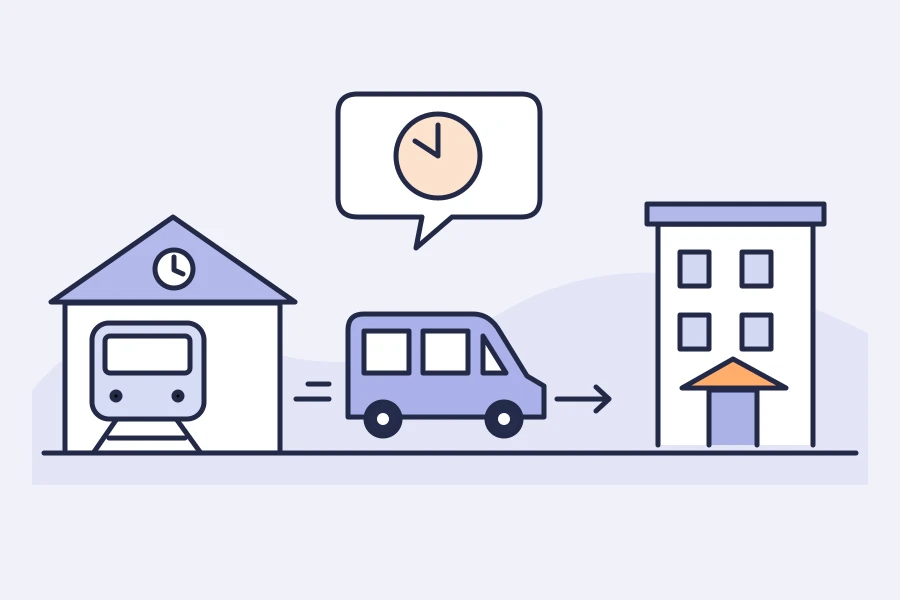
“Our train arrives at 9:40 pm on Saturday. Which hotel near the station can pick us up?” A traveller might ask an artificial intelligence (AI) assistant: a service you can type questions into and receive answers from. But does the answer include everything needed to plan the arrival? Let’s use a fictional example: a shuttle that leaves at 10 pm but must be booked by 6 pm.
1. Ask a question guests often ask you
Choose a common front desk question without including guests’ names or personal details. You can run two different checks: one to see which hotels are suggested, and another to check the information about your own.
-
To find a hotel: “I arrive in [destination] by train at 9:40 pm on Saturday. Which hotels offer a shuttle from the station?” Always name the place: without a destination, the question is too broad.
-
To check your hotel: start a new conversation and ask “Does Hotel [name, location] have a shuttle from the station at 10 pm on Saturday? Do I need to book? By what time? Show me the page with this information.” You can do this even if your hotel was not in the first answer.
2. Check whether an important detail is missing
Back to the shuttle at our fictional hotel. Its website says: “On Saturdays, the last shuttle leaves the station at 10 pm. Booking is required by 6 pm.” Compare these two possible answers.
-
Incomplete answer: “Yes, the shuttle leaves at 10 pm.” The time is right, but the requirement to book by 6 pm is missing. The guest might only find out at the station, when it is too late to book.
-
Complete answer for this example: “Yes, on Saturdays the shuttle leaves the station at 10 pm, but you must book by 6 pm.” The guest now knows both when it leaves and what to do to use it.
If the website only says “shuttle available”, you do not have enough information to confirm either 10 pm or the booking deadline. Ask whoever manages the service and clarify the page. The same check applies to other services: parking, for example, may be available but require a reservation.
3. Open the link and read the hotel’s page
Do not stop at the answer itself. Open the links provided by the assistant and check that they refer to the right hotel, season and day. In our example, also check that 10 pm is the departure time from the station, not from the hotel. A summer timetable may not apply in winter.
If the assistant gives no link, find the page on the hotel’s official website yourself. In your notes, write “page found by me”. This distinguishes what the assistant showed from what you checked yourself.
4. Note the problem and decide who can fix it
A short note shared with colleagues is enough. Save the date, language, assistant or search engine name, exact question and answer. Add the link you checked and what you found. For example: “The answer says shuttle at 10 pm. The website also says book by 6 pm. That detail is missing from the answer.”
-
If information is missing from the hotel website, ask whoever manages the page to add it after confirming it with the person responsible for the service.
-
If the website is clear but the AI answer is wrong or incomplete, keep the example and report it to the service if that option is available. You cannot directly edit an external answer as you would a page on your own website.
-
If a detail is still uncertain, mark it “to confirm” and ask the person responsible. For example: is the shuttle running this Saturday too? Do not treat an answer as correct just because it sounds plausible.
Why even a short answer is worth checking
Pew Research Center examined Google searches by 900 US adults in March 2025. Visits with an AI summary were associated with fewer clicks on traditional results. In a separate 2026 survey, US adults reported using chatbots to look up information. These studies describe different settings. For your hotel, the immediate question is narrower: if guests read only that answer, would they know what to do before 6 pm?
Pew: Google searches and clicks (2025)
Pew: survey on chatbot use (2026)
After a correction or report, ask the same question again and keep the new answer too. Answers can change: one check does not guarantee they will always be correct. The check remains simple: in our example, does the answer also say to book by 6 pm? That detail helps the guest plan ahead.
FROM READING TO PRACTICE
How might travellers choose a hotel?
Follow the guest from the first question to an offer they can book.
Read how AI enters the hotel shortlist →